

Team
Lead Product Designer (That's me🙋♀️)
Product Manager, ML Engineer, Frontend Engineer,
QA Engineer, VP of Product
Timeline
12 Weeks
Context
Concept product exploring how engineering teams can preserve decision history, code rationale, and risk context directly inside their workflow.
Goal
To surface contextual reasoning, decision history, and risk directly inside the coding workflow.
Impact
14 min → 6 min
Time to context
18 hrs → 7 hrs
Senior interrupt time
My Contribution
AI codes fast.
Reviewing it creates uncertainty.
The challenge
Make code review feel faster and more confident without losing context.
Our approach and outcome
By combining stakeholder input with user research, I refined the problem space and narrowed the project to a single goal: reducing uncertainty in code review through clearer context.
Research
20 user interviews with SaaS professionals and a competitive audit of 4 AI analytics tools
8
stakeholder conversations
20+
product references reviewed
3
core workflow concepts explored
“I can see the change, but I still don’t know why the AI made it.”
Lack of context
Developers need to know why the AI made a change.
“I don’t want to blindly approve code because it looks correct.”
Low trust
Even good suggestions can feel risky without clear signals.
“Reviewing AI should feel faster, not more mentally draining.”
Review overhead
Switching between different tools slows the review process.
FEATURE 1
Why Layer: Contextual reasoning
behind every code decision
Scenario
Priya opens retry.ts for the first time. Cursor tells her what the function does. Nobody can tell her why it's written this way or what breaks if she changes it.
For example: Why Layer gives developers the context a senior engineer would share before handing off a file without needing to find that engineer.
Solution: Why Layer
Why Layer surfaces the reasoning, decision history, related tickets, and code context directly alongside the function, helping engineers understand why the code exists before they change it.
Context Clarity
Code Understanding


FEATURE 2
Scenario
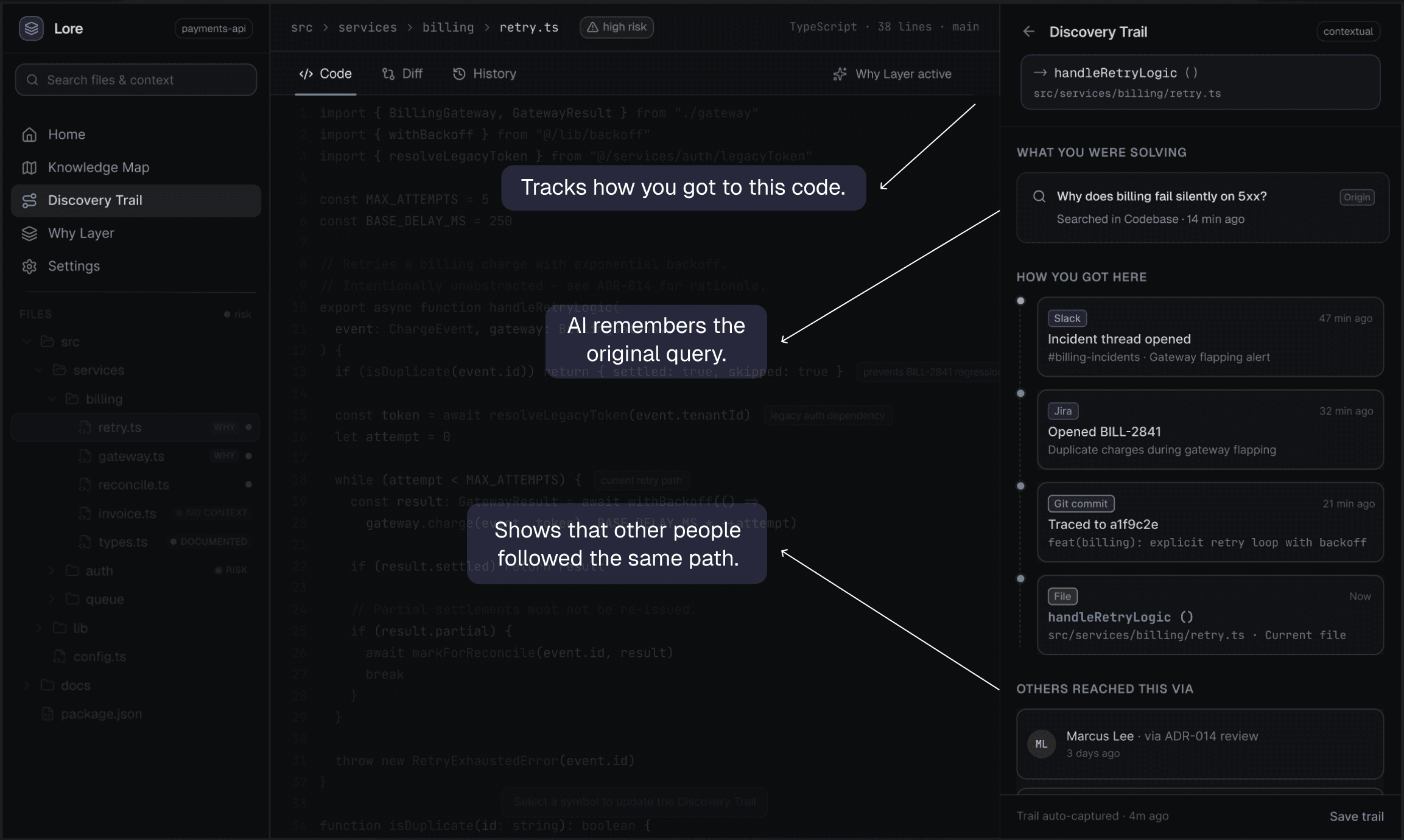
When debugging unfamiliar code, engineers often lose time retracing the steps, searches, tickets, and discussions that led them there.
A developer investigating a billing bug may open the right file, but still not know which incident, ticket, or commit revealed the root cause.
Solution: Discovery Trail
Discovery Trail shows the investigation path behind a code decision by surfacing the original question, linked artifacts, and sequence of actions that led to the current file version.
Trust Building
Risk Reduction

FEATURE 3
Risk Profile: Exposing hidden code
risk before engineers make changes
Scenario
Engineers often modify unfamiliar code without knowing the operational risk, ownership gaps, or past incidents tied to that area.
A developer may update a billing function without realizing it touches legacy auth, caused a previous incident, or lacks clear documentation.
Solution: Risk Profile
Risk Profile surfaces hidden technical and organizational risk directly in the workflow, helping engineers identify fragile code, understand potential impact, and make safer decisions before shipping changes.
Review Flow
Process Friction


Retrospective Analysis
What changed
I gained hands-on experience using Baymard guidelines to identify usability issues and optimize shopping flows, which resulted in a smoother and more intuitive user experience for customers on the e-commerce platform.
What I learned
I learned how to handle disagreements within the team by actively listening to all perspectives, facilitating open discussions, and guiding the team toward common goals. This improved our decision-making and teamwork, leading to stronger project outcomes.

Still Scrolling?
Say hello or keep up the friendly snooping 👀
Open to new positions. Let’s work together!
...✨ Fueled by caffeine, late nights, and lots of music @ 2025